How Do Motorized Louvered Pergolas Work? A New Jersey Homeowner's Guide

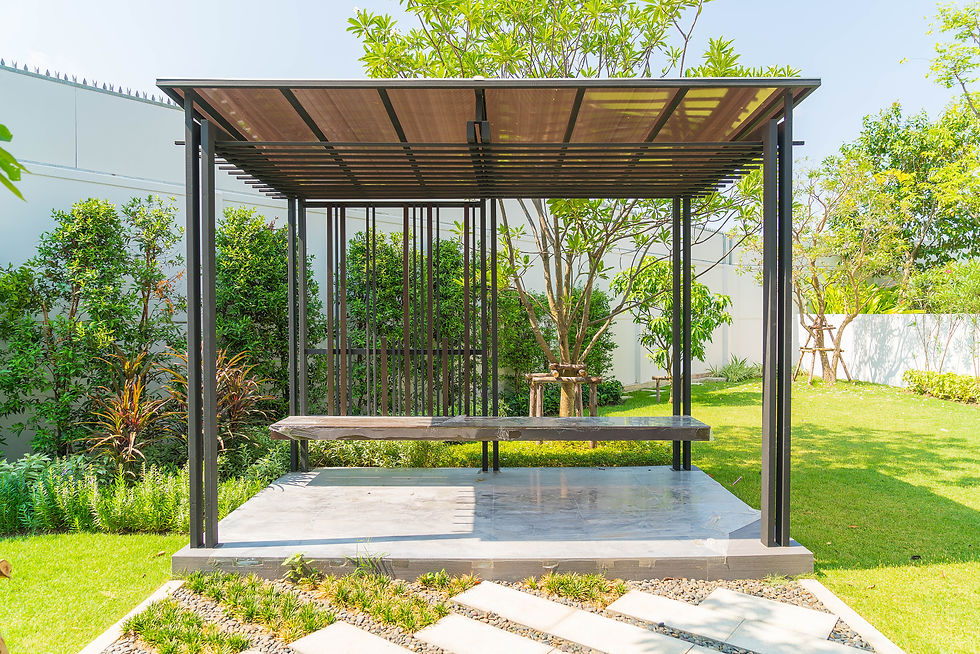
A motorized louvered pergola works by rotating a roof of aluminum blades, called louvers, on a hidden pivot system driven by a small electric motor. Press a button and the louvers turn from fully open, which lets sun and air through, to fully closed, which forms a solid, water-shedding roof. Rain runs into channels built into the louvers, drains through the beams and posts, and exits at ground level.
That single mechanism is what separates a louvered pergola from every other shade structure. A traditional wood pergola gives you fixed, partial shade whether you want it or not. A retractable awning gives you shade or no shade, with nothing in between. A louvered pergola lets you dial in the exact amount of sun, shade and airflow you want, then close the roof completely when a storm rolls in off the shore.
If you have been searching for how these systems actually operate before spending money on one, this guide covers the mechanics, the real-world behavior in New Jersey weather, and the questions worth asking any pergola contractor before you sign.
The four parts of a motorized louvered pergola
Every system, regardless of brand, is built from the same four components.
1. The louvers
These are the blades that form the roof. On quality systems they are extruded aluminum, hollow, and powder-coated. Aluminum matters here: it will not rot, warp, splinter or need staining the way a wood pergola does, and it will not rust the way steel can in salt air. For homes near the water in Margate, Ocean City, Avalon or Stone Harbor, that corrosion resistance is not a luxury feature, it is the reason the structure survives.
Each louver is shaped with an internal channel. When the roof closes, the louvers overlap, and those channels line up into a continuous gutter.
2. The drive system
A small electric motor, usually concealed inside the perimeter beam, drives a linkage bar connected to every louver. Turning one motor turns all the louvers together, in sync, at the same angle. Most systems rotate through a range of roughly 0 to 160 degrees, which is enough to go from fully closed to nearly vertical.
The motor draws very little power. It only runs during the few seconds the louvers are actually moving, so it is not adding meaningfully to your electric bill.
3. The drainage path
This is the part homeowners underestimate, and it is the part that determines whether you can actually sit outside in the rain.
Closed louvers channel water sideways into the perimeter beam. The beam carries it to the corner posts, which are hollow and act as downspouts. Water exits at the base of the post, usually below grade or onto the patio surface away from the seating area. Nothing drips into the middle of your space.
A system without integrated drainage will dump water off the front edge in a sheet. Ask to see where the water goes. It is the fastest way to tell a well-engineered system from a cheap one.
4. The controls
At minimum, you get a handheld remote. Better systems add:
A wall-mounted switch, so the remote living in the couch cushions is not a crisis.
Smart home integration, so the roof can be operated from a phone app or a voice assistant alongside your other automation.
A rain sensor, which closes the louvers automatically when it detects moisture. This is the single most useful accessory. It protects your outdoor furniture on the weekday afternoon when nobody is home.
A wind sensor, which opens the louvers in high wind so the structure presents less resistance to a gust.
What happens when you press the button
Louver position | What it does | When you would use it |
Fully open (vertical) | Maximum sun and maximum airflow; the roof reads as open sky | Cool spring and fall afternoons, star-gazing, letting heat escape |
Partially open (angled) | Filtered light with heat venting upward | Most summer days; the position people leave it in |
Angled away from the sun | Blocks direct sun while keeping the view and breeze | Late afternoon west-facing patios, glare control |
Fully closed | Solid, water-shedding roof | Rain, midday sun, protecting furniture, or an outdoor kitchen you want usable in any weather |
The useful thing about the angled positions is heat. A closed roof stops sun but also traps warm air underneath. An angled roof blocks the direct beam while still letting hot air rise and escape between the blades. In a humid New Jersey July, that difference is noticeable.
How a louvered pergola compares to the alternatives
Motorized louvered pergola | Retractable awning | Traditional wood pergola | |
Shade control | Infinitely adjustable, plus fully closed | Extended or retracted only | Fixed, partial |
Rain protection | Yes, with drainage | Light rain only; must retract in wind | No |
Airflow when shaded | Yes, adjust louver angle | No, fabric blocks airflow | Yes, but no rain cover |
Structure | Permanent, engineered, foundation or deck-mounted | Mounted to the house wall | Permanent |
Maintenance | Rinse; occasional motor check | Fabric cleaning, motor service | Staining, sealing, rot and insect treatment |
Investment | Highest | Lowest | Middle |
Best for | Homeowners who want a genuine outdoor room used most of the year | Occasional shade over an existing patio or deck | Appearance, plant support, budget |
If you are still deciding between structure types, our retractable awnings vs pergolas comparison walks through the trade-offs in more detail.
How motorized louvered pergolas handle New Jersey weather
New Jersey asks a lot of an outdoor structure: humid summers, coastal wind, salt air along the shore, and real snow load in winter. Here is how the systems respond.
Summer sun and heat. Angle the louvers away from the sun's position and you block the direct beam while venting hot air upward. Adding motorized screens on the sides handles low afternoon sun that comes in horizontally, which no roof can stop.
Rain. A closed roof with integrated drainage keeps the space dry through ordinary rain. This is the feature that changes how often the space gets used, because the barbecue no longer gets cancelled at 4pm.
Wind. Aluminum louvered pergolas are engineered structures with rated wind performance, and that rating depends on the installation: footing depth, post anchoring and attachment method. Coastal installations in Cape May and Atlantic County need to be specified for the exposure they will actually see. Ask for the wind rating in writing, and ask what installation conditions that rating assumes.
Snow. Louvers should be left open in winter. Open louvers let snow fall through rather than accumulate as a load on a closed roof. Most systems specify this in the manual, and some automatically open above a certain load. If a contractor cannot tell you the snow load rating, that is a meaningful gap.
Salt air. Powder-coated aluminum with stainless fasteners is the correct specification near the water. Confirm the fastener material, not just the frame material. Fasteners are where corrosion usually starts.
What the installation actually involves
Homeowners are often surprised that this is a construction project, not a delivery.
Design and measure. Span, height, attachment method and louver direction are decided based on your patio and the sun's path. Louver orientation matters, because the blades block sun best when they rotate against the sun's angle.
Structural support. Freestanding units need footings. Attached units need a solid ledger connection into framing, not just into siding. On decks, the deck framing may need reinforcement to carry the load.
Permits. Most New Jersey municipalities treat a permanent pergola as a structure requiring a permit, and many shore towns have additional wind and setback requirements. Your installer should handle this. If they suggest skipping it, that is a problem for you later at resale.
Electrical. The motor needs power. That may mean running a dedicated circuit, which is easiest to plan before the patio is finished rather than after.
Assembly and commissioning. Frame, posts, louvers, motor, controls, then testing the full range of motion, the drainage and any sensors.
Six questions to ask before you buy
Where does the water go? Ask them to trace the path from louver to ground.
What is the wind rating, and under what installation conditions? A number with no installation assumption behind it is marketing.
What is the snow load rating, and what is the winter position?
What is the warranty on the frame, the finish and the motor separately? These are usually three different terms, and the motor is often the shortest.
Who services the motor, and how long do replacement parts stay available? A proprietary motor from a brand that exits the market is a future problem.
Is the permit included? Get the answer before the contract, not after.
Add-ons worth considering at design time
These are far cheaper to plan for now than to retrofit later, because they need wiring and structural provision.
Integrated LED lighting in the beams, which is the difference between a space used until 8pm and one used until 11pm.
Motorized side screens for insects, low sun and privacy. See our outdoor shade solutions overview for how these combine.
Infrared heaters mounted in the frame, which extend the usable season into late fall.
Rain and wind sensors, as above.
Sliding glass or panel walls on one or more sides for full three-season enclosure.
Run the wiring during installation even if you defer the fixtures. Opening a finished aluminum beam later is expensive.
Is a motorized louvered pergola worth it in New Jersey?
It depends entirely on how you plan to use the space.
It is worth it if you want an outdoor room that works in most weather, you are building or renovating an outdoor kitchen or seating area you intend to use regularly, or your patio is currently unusable for half the reasons weather provides. The value comes from converting a space you use occasionally into one you use constantly.
It is probably not worth it if you need shade over an existing patio a few weekends a year. A retractable awning delivers most of that benefit for considerably less.
Cost depends on span, height, attachment method, site conditions, finish and add-ons, so any figure quoted without seeing your property is a guess. We give firm pricing after a site visit.
Serving South Jersey and the shore
NJ Motorized Screens & Awnings Phone: (609) 846-3102 Email: zach@njmotorizedscreensandawnings.com
We design and install motorized louvered pergolas, motorized patio screens, retractable awnings and Bahama shutters across Atlantic, Cape May, Camden, Burlington, Ocean and Salem Counties, including Margate City, Ocean City, Avalon, Stone Harbor, Wildwood, Long Beach Island, Egg Harbor Township, Cherry Hill, Marlton, Haddonfield, Deptford and Toms River, plus Philadelphia and Bucks County, PA.
See finished installations in our gallery, or request a free consultation.
FAQ Section
How do motorized louvered pergola systems work?
A motorized louvered pergola works by rotating a roof of aluminum blades on a hidden linkage driven by a small electric motor. Pressing a remote or wall switch turns all the louvers together, from fully open for sun and airflow to fully closed for a solid, water-shedding roof. Rain collects in channels inside the louvers, drains through the beams and hollow posts, and exits at ground level.
What is a louvered pergola?
A louvered pergola is a pergola whose roof is made of adjustable slats rather than fixed beams. The slats rotate so you can control how much sun, shade and airflow reaches the space beneath, and close them completely for rain protection.
Are motorized louvered pergolas waterproof?
When the louvers are fully closed and the system has integrated drainage, the space underneath stays dry in ordinary rain. It is water-shedding rather than sealed like a roof, so wind-driven rain can still enter from the open sides. Adding motorized side screens or panels addresses that.
Do louvered pergolas work in snow?
Yes, but the louvers should be left open through winter so snow falls through instead of loading a closed roof. Every system has a specified snow load rating and a recommended winter position. Ask your installer for both in writing.
How long do motorized louvered pergolas last?
The aluminum structure is the long-lived part, since powder-coated aluminum does not rot, warp or rust and needs only occasional rinsing. The motor and electronics are the serviceable components. Ask for the frame, finish and motor warranties separately, because they are usually different lengths.
Do motorized louvered pergolas need a permit in New Jersey?
Usually yes. Most New Jersey municipalities treat a permanent pergola as a structure requiring a building permit, and shore towns often add wind and setback requirements. A reputable installer handles the permit as part of the project.
Can a louvered pergola be attached to my house?
Yes. Attached configurations connect to the house with a structural ledger fastened into framing, not into siding alone. Freestanding versions use their own posts and footings. Which one suits you depends on your roofline, door heights and patio layout.
What happens if the motor fails?
Most systems include a manual override so the louvers can still be positioned without power. Ask specifically whether yours has one, who services the motor locally, and how long replacement parts remain available for that brand.
Do the louvers block heat as well as sun?
Angled louvers block heat better than closed ones. A closed roof stops the sun but traps warm air underneath, while an angled roof blocks the direct beam and still lets hot air rise and vent between the blades. That is why most people leave the louvers partially open on hot days.
Louvered pergola or retractable awning: which should I choose?
Choose a louvered pergola if you want a genuine outdoor room usable in most weather, with adjustable shade, airflow control and rain protection. Choose a retractable awning if you mainly need occasional shade over an existing patio at a lower investment. The pergola is a structure; the awning is an accessory to one.

Comments